

Almost everyone who books a Try the Wheel class tells us the same thing when they arrive. Some version of: I should warn you, I'm going to be really bad at this.
You will be. That isn't a reason to stay home — it's the entire point of a first class, and it's worth clearing out of the way early so we can talk about the things people actually want to know and are slightly too polite to ask.
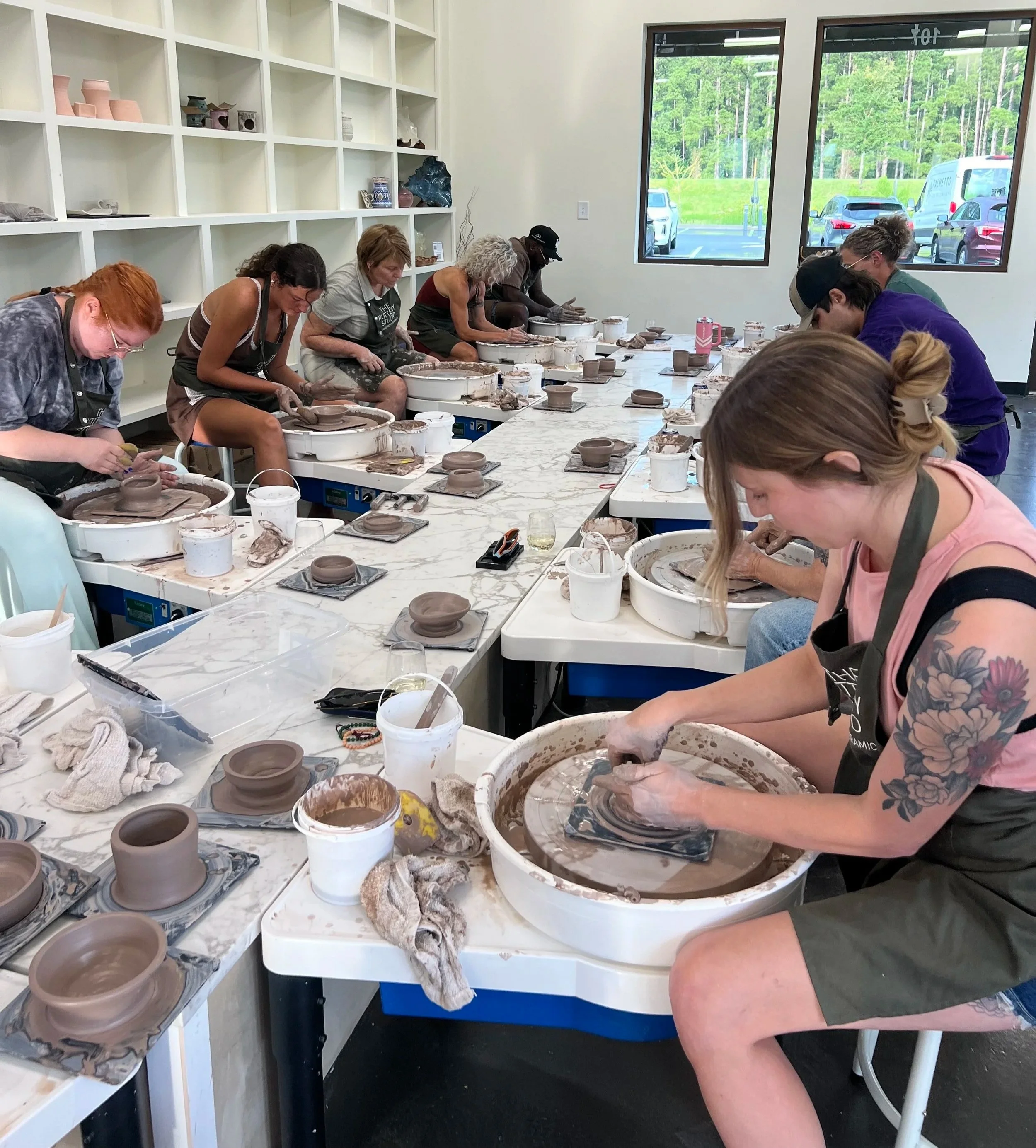
Here's what the two hours look like, start to finish.
Before you arrive
Book ahead. Walk-ins aren't guaranteed a wheel, and a class that looks open on Tuesday can be full by Friday. If you need to cancel, you get a full refund up to 48 hours before.
Come fifteen minutes early. That sounds like the thing every business says, but there's a reason for it here — checking in, finding your wheel and getting an apron on takes a few minutes, and the setup and safety instructions at the start are the ones you'll actually want to have heard.
Wear something you don't mind messing up. Wet clay comes out of most fabric, but not all of it, so this is not the night for anything you're fond of. Closed-toe shoes, long hair tied back, and take your rings off before you start — clay packs in underneath a ring, and a ring on your finger will quietly drag a line through the wall of whatever you're making.
Everything else is ours. Clay, tools, aprons and all the firing are included in the $95, so there's nothing to buy and nothing to bring. If you're someone who likes writing things down, bring a notebook. Plenty of people do.
Walking in
Wheel classes are capped at twelve, which means the room is full but never crowded. There's time for someone to come over and put their hands over yours when it isn't working — which it won't be, at first.
Two hours sounds short and isn't. It's long enough to get properly messy, long enough to fail at something several times, and long enough that most people are surprised when it's over.
The hard part is centering, and that's normal
Everything you make starts with getting the clay to sit true in the middle of a spinning wheel. Until it does, the clay fights you — it shoves your hands off, pulls to one side, and generally behaves like it has an opinion about the evening.
This is the part that takes longest to learn, and it has almost nothing to do with being artistic. The instinct is to push harder. The trick is close to the opposite: brace your arms, hold still, and let the wheel do the work while you simply refuse to move. People who are good at this look like they're barely doing anything at all.
Your first attempt may well collapse. Possibly your second. Nobody's first pot is their first attempt, and anyone who tells you otherwise is rounding up.
That's also why we don't hand you a finished object and call it a class. You're not here to be given a pot. You're here to find out what clay does under your hands, and that only happens through the attempts that don't work.
Nothing goes home with you that night
This is the part that surprises people most, so it's worth being plain about: you will leave empty-handed, and that's exactly how it's meant to go.
A finished piece of pottery has been through a long chain of steps. Straight off the wheel it's too soft to even move safely, so it has to dry slowly over days — rush it and it cracks. Then it goes through a first firing, which turns dried mud into actual ceramic. Then it's glazed. Then it's fired a second time, much hotter, which melts the glaze into a thin layer of glass.
For Try the Wheel classes, our staff handles the glazing and both firings, so there's nothing you need to come back and finish. Your piece will be ready roughly three to four weeks after your class, and you collect it during Open Studio hours.
Three to four weeks feels long when you've just made something. It's also the reason the thing you eventually pick up is a real piece of pottery rather than a souvenir.
When you pick it up
It will be heavier than you remember and almost certainly not quite round. Hold on to it anyway.
The slight wobble in the rim is a record of a specific two hours of your life in which you learned something with your hands, and the pieces people keep on the shelf longest are rarely the technically good ones. We have students three courses in who still drink out of the first mug they made, which is objectively the worst mug they own.
If it takes
Try the Wheel is one evening with nothing attached to the end of it. Most people come once out of curiosity, and that's a perfectly good reason.
But it takes for a lot of people, and if it takes for you, 6 Week Clay 101 is the natural next step — fifteen hours at the wheel instead of two, your own shelf in the studio, glazes included, and Open Studio access so you can come in and practise between classes. That's the difference between having tried pottery and actually learning it.
Classes are for ages twelve and up. No experience needed, here or there.
